

A low block only works if the team behind it can breathe. Austria came to Los Angeles to suffocate space, and for half an hour they did it well — but a compact shape is only a plan if you can move the ball out from under it, and Austria never could.
Spain's response was patient and merciless: manufacture a free man in the same channel again and again, cycling through Rodri, Pedri and Marc Cucurella until Ralf Rangnick's block stopped being a barrier and became a stage for Spanish control.
The Shapes
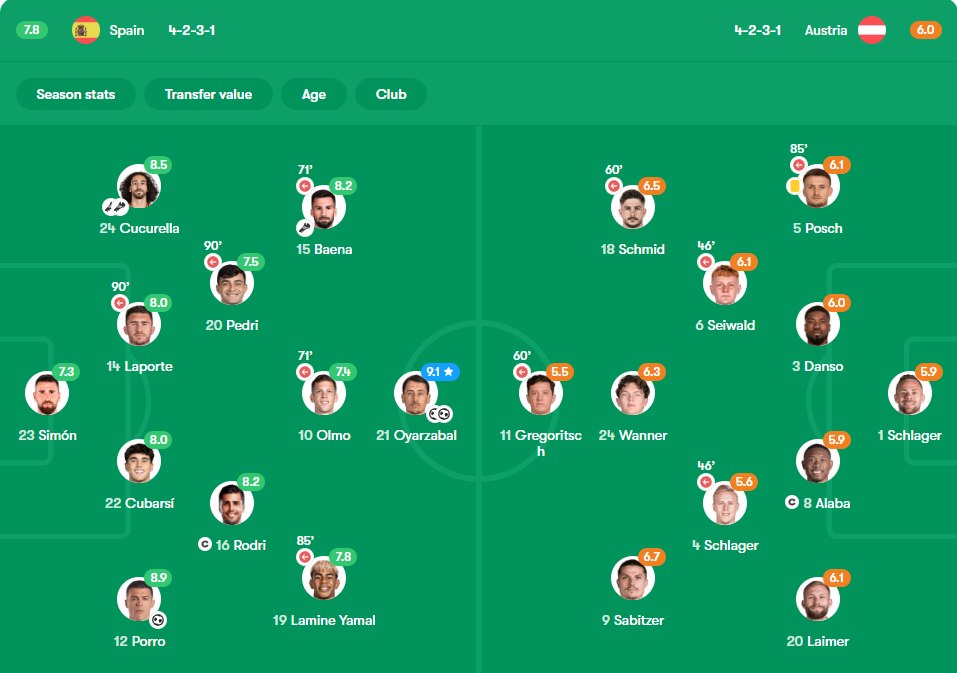
Luis de la Fuente set Spain in a 4-2-3-1 that breathed into a 4-3-3 in possession. Unai Simón started behind a back four of Pedro Porro, Pau Cubarsí, Aymeric Laporte and Marc Cucurella. Rodri wore the armband as the anchor, with Pedri beside him as the pivot who kept stepping into the half-spaces to carry and set tempo. Álex Baena drifted inside from the right, Dani Olmo linked as the No. 10, Lamine Yamal held the left before cutting in, and Mikel Oyarzabal led the line as a mobile nine who lived off the shoulder of the last defender.
Rangnick answered with a 4-2-3-1 built to defend deep and narrow. Alexander Schlager started behind Stefan Posch, Kevin Danso, David Alaba and Konrad Laimer, with Xaver Schlager and Nicolas Seiwald screening in front. Romano Schmid and Marcel Sabitzer flanked Paul Wanner behind lone striker Michael Gregoritsch. David Alaba captained the side.
De la Fuente's changes were pure management: Mikel Merino and Ferran Torres for Olmo and Baena on 71 minutes, Gavi for Yamal on 85, and a late double of Fabián Ruiz and Marc Pubill in stoppage time. Rangnick moved earlier and more often — Grillitsch and Chukwuemeka at half-time, Kalajdzic and Arnautović on the hour, and Prass for Posch on 85, two minutes after Posch was booked.
Spain's Rotating Overloads
The mechanism that broke Austria open was not width, it was Spain's refusal to let their spine stand still. Rodri stayed fixed as the base while Pedri pushed into the half-spaces on almost every settled possession, dragging one of Austria's two pivots out of position and opening lanes into Baena and Oyarzabal between the lines. With Austria's full-backs pinned by Yamal and Baena's inward runs, Cucurella kept finding himself free in space no starting left-back should have. Spain's 64 percent possession and 91 percent pass accuracy were the residue of that constant relocation — 295 of their passes landed in Austria's half against just 88 of Austria's in theirs.
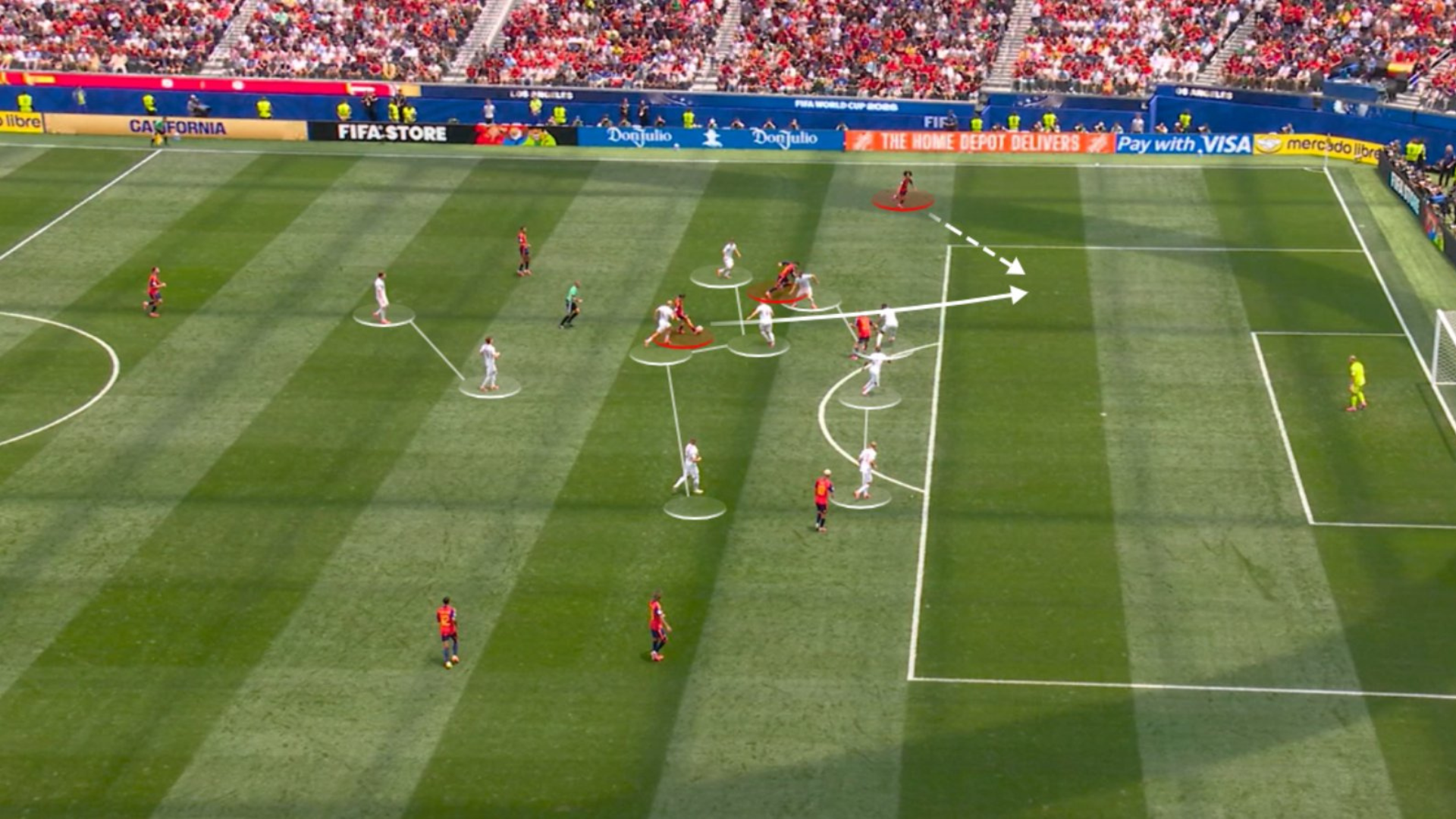
- Pedri carries through midfield unchallenged, buying Spain time to reset.
- Oyarzabal and Baena drift inside, pulling Posch narrow and vacating the left.
- Cucurella, unmarked, lifts his head and delivers.
- Oyarzabal steps back onside and finishes between Danso and Alaba.
Austria's Disconnected Block
Rangnick's shape was disciplined but starved. The principle held for half an hour — bodies behind the ball, the centre screened — yet Austria never solved how to progress once they won it. They managed 346 passes to Spain's 629, and the telling detail is where they died: only 88 reached Spain's half. Xaver Schlager and Seiwald dropped so deep to build that Wanner was marooned between the lines with no triangle around him, hunted every time he received.
The long ball became the only outlet, and it betrayed them — 14 completed at 38 percent into a Spain side winning 80 percent of its aerials. Gregoritsch spent the night alone; Austria mustered just 11 touches in the Spanish box to Spain's 51. Their one flicker of threat came just before the hour, and they spurned it — and within minutes Spain had made them pay at the other end. Every time a full-back stepped up, the space behind him invited Spain's transitions, and that tension never resolved across ninety minutes.
The Cucurella–Baena Left Channel
If one zone decided the match, it was Spain's left and inside-right seam. Cucurella's runs were built to bend Austria's back line rather than simply overlap, and Baena's habit of drifting inside from the right created a diagonal that scrambled Austrian marking.
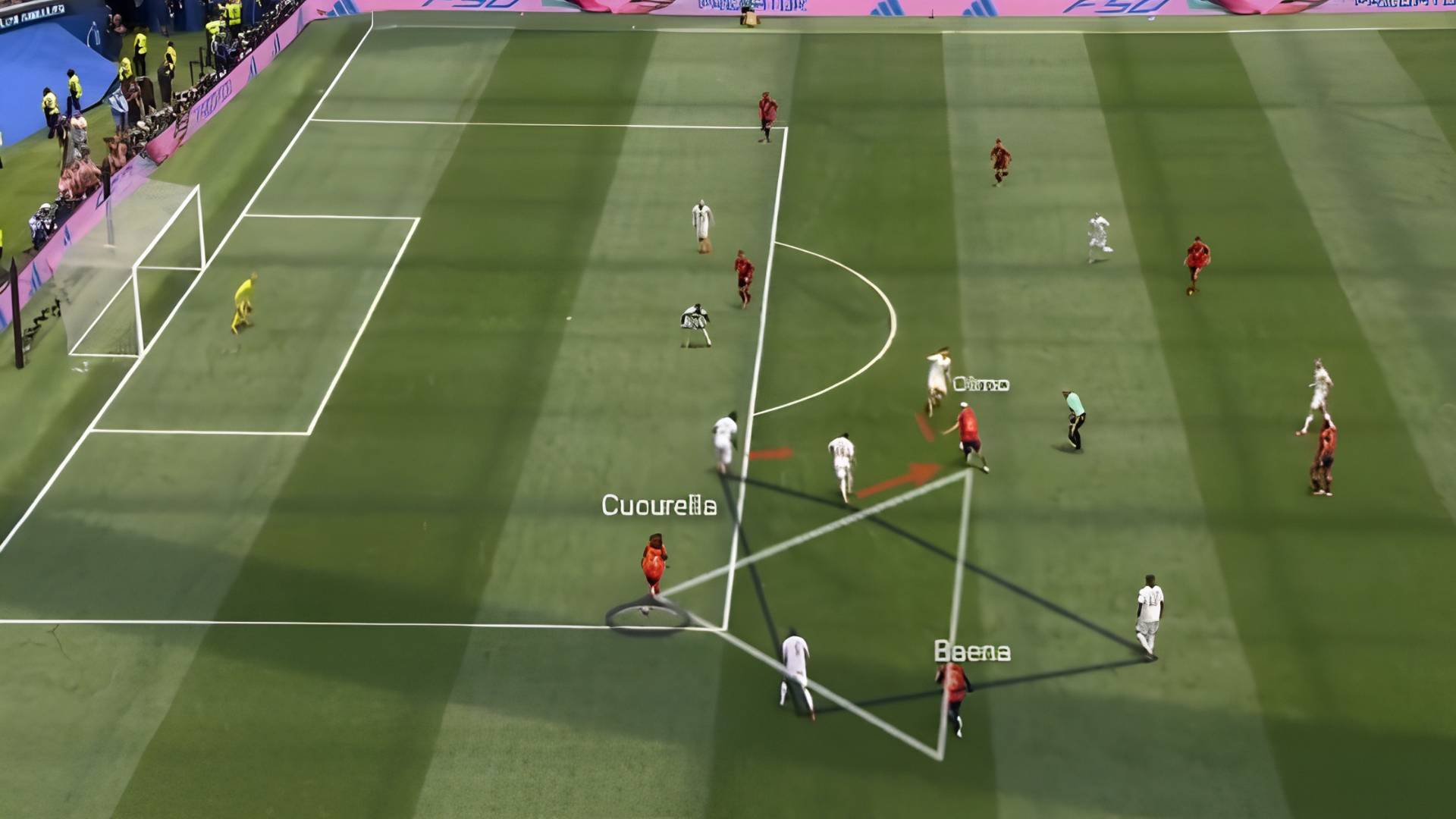
- Spain work the left; Baena drifts inside from the right into the seam.
- Baena reaches the byline and pulls it back across the face of goal.
- Pedro Porro surges all the way from right-back into the box.
- Porro heads past Schlager — positional courage few teams risk.
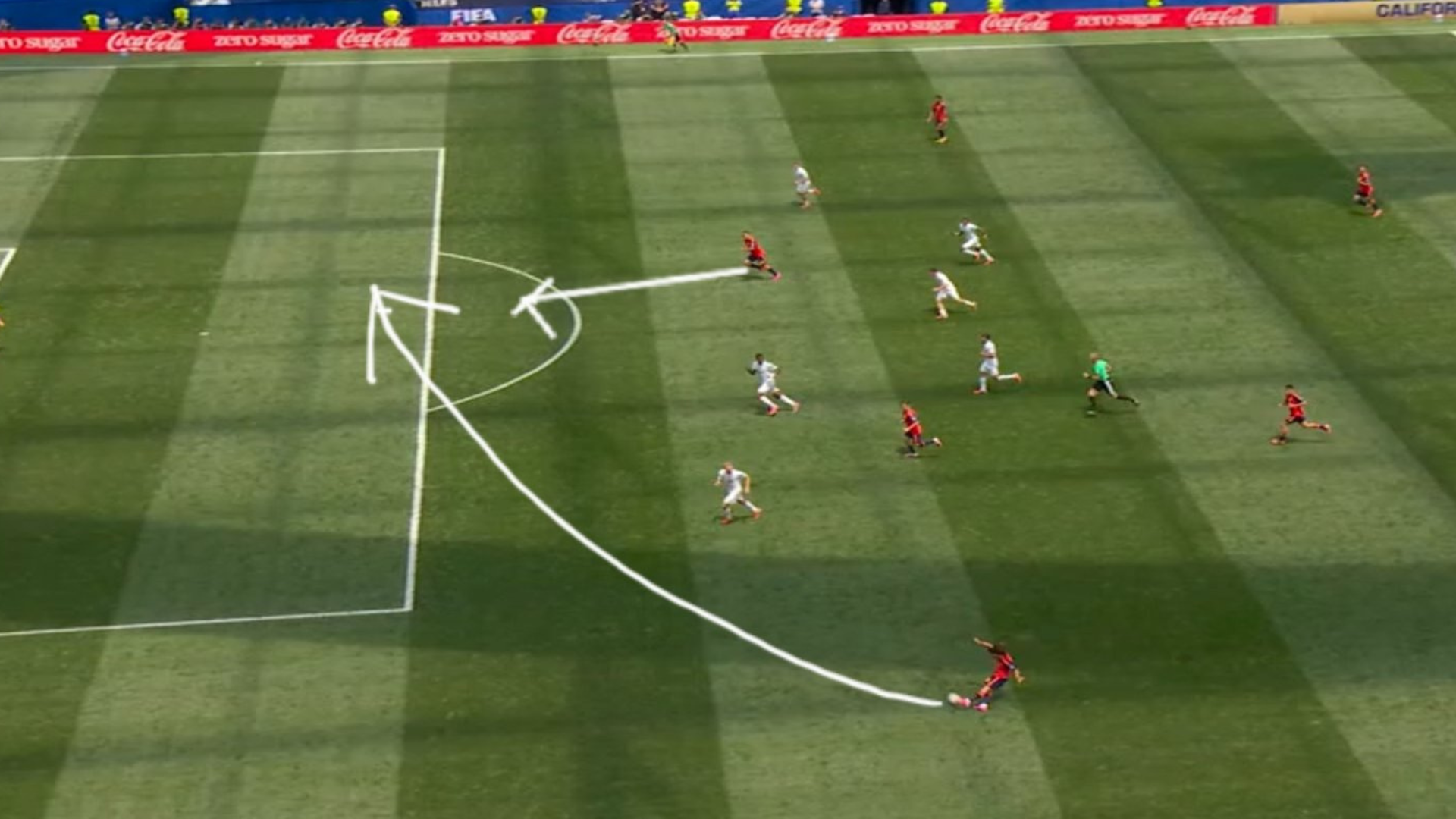
- Laporte's long ball releases Cucurella down the left once more.
- Cucurella drives and floats in a searching delivery.
- Oyarzabal peels off the last defender into the box.
- Oyarzabal slots low into the bottom corner to complete his brace.
It might have been three assists: Cucurella's own header from a Yamal corner was chalked off by VAR for goalkeeper interference. On another night the left-back walks off with a goal and two assists; as it was, he simply architected the win.
The 36th Minute
Oyarzabal's opener was the hinge. Austria had defended their box respectably for half an hour, conceding territory but little clear sight of goal, and a goalless first half would have handed Rangnick something to build on. Instead the manner of the goal — Spain drawing a defender out by design rather than forcing anything — told Austria their shape could be unpicked at will. Their second-half answer was reactive, not corrective, and the balance never swung back.
Changes That Never Changed It
Rangnick's half-time double, Grillitsch and Chukwuemeka for the two deep midfielders, was meant to win second balls and inject legs, but it did nothing about the core problem of no support around the ball. The hour-mark switch to Kalajdzic and Arnautović chased an aerial route that never arrived, because Austria could not generate the service, finishing with 20 percent of aerials won. De la Fuente, by contrast, changed nothing structural: Merino and Torres freshened tired legs with the game already won, and Gavi's late arrival simply tightened the midfield as it wound down.
The Numbers
| SPAIN | AUSTRIA | |
|---|---|---|
| Possession | 64% | 36% |
| xG | 2.84 | 0.32 |
| Shots (on target) | 23 (10) | 5 (0) |
| Big chances created | 4 | 1 |
| Pass accuracy | 91% (629) | 82% (346) |
| Passes into opp. half | 295 | 88 |
| Long balls completed | 23 (66%) | 14 (38%) |
| Aerial duels won | 80% | 20% |
| Touches in opp. box | 51 | 11 |
| Corners | 9 | 0 |
| Saves | 0 (Simón) | 6 (Schlager) |
| Fouls | 8 | 15 |
Cards: Stefan Posch (Austria) yellow, 83'. Subs — Austria: Grillitsch, Chukwuemeka 46', Kalajdzic, Arnautović 60', Prass 85'. Spain: Merino, Torres 71', Gavi 85', Fabián Ruiz, Pubill 90'+3.
Who Shaped It
Scored twice, on 36 and 89 minutes, timing his movement off the last defender so cleanly that Danso and Alaba spent the night a half-step behind him. The definitive difference-maker.
The game's architect: two assists, a disallowed header, and a stream of bending runs that pulled Austria's back line out of shape every time Spain came left.
Headed the second on 66 minutes and embodied Spain's willingness to flood the box from full-back — a constant extra body beyond the front line.
Wore the captaincy with a calm that never needed to force the game, holding the base so everyone ahead could gamble forward without fear of the counter.
Supplied the assist for Porro and was central to the left-sided combinations before making way on 71 minutes with his work done.
The engine of the mechanism, stepping into the half-spaces to set tempo and drag Austria's midfield out of its lines.
A spectator in the truest sense — zero saves, untested for ninety minutes as Austria failed to register a single shot on target.
Made six saves and was Austria's busiest and most blameless player, the only reason the scoreline stayed respectable.
The story of Austria's disconnect: a No. 10 marooned between the lines with no support around him, starved of the ball his side could never progress.
Organised a back line through a difficult night, rarely beaten by pace or brilliance so much as by the lack of help in front of him.
Control, By Design
This was a tactical idea executed with total clarity: relocate numbers until a free man appears, then punish the space. De la Fuente's Spain leave Los Angeles with real tournament credentials — the pressing triggers, the wide rotations and the control of both boxes suggest a side built to go deep, and their left-sided combination play looks among the most reliable in the competition.
Rangnick's Austria showed shape without a supply line; unless they find a way to support the ball-carrier and escape their own third, their World Cup will be remembered for organisation without an end product.